
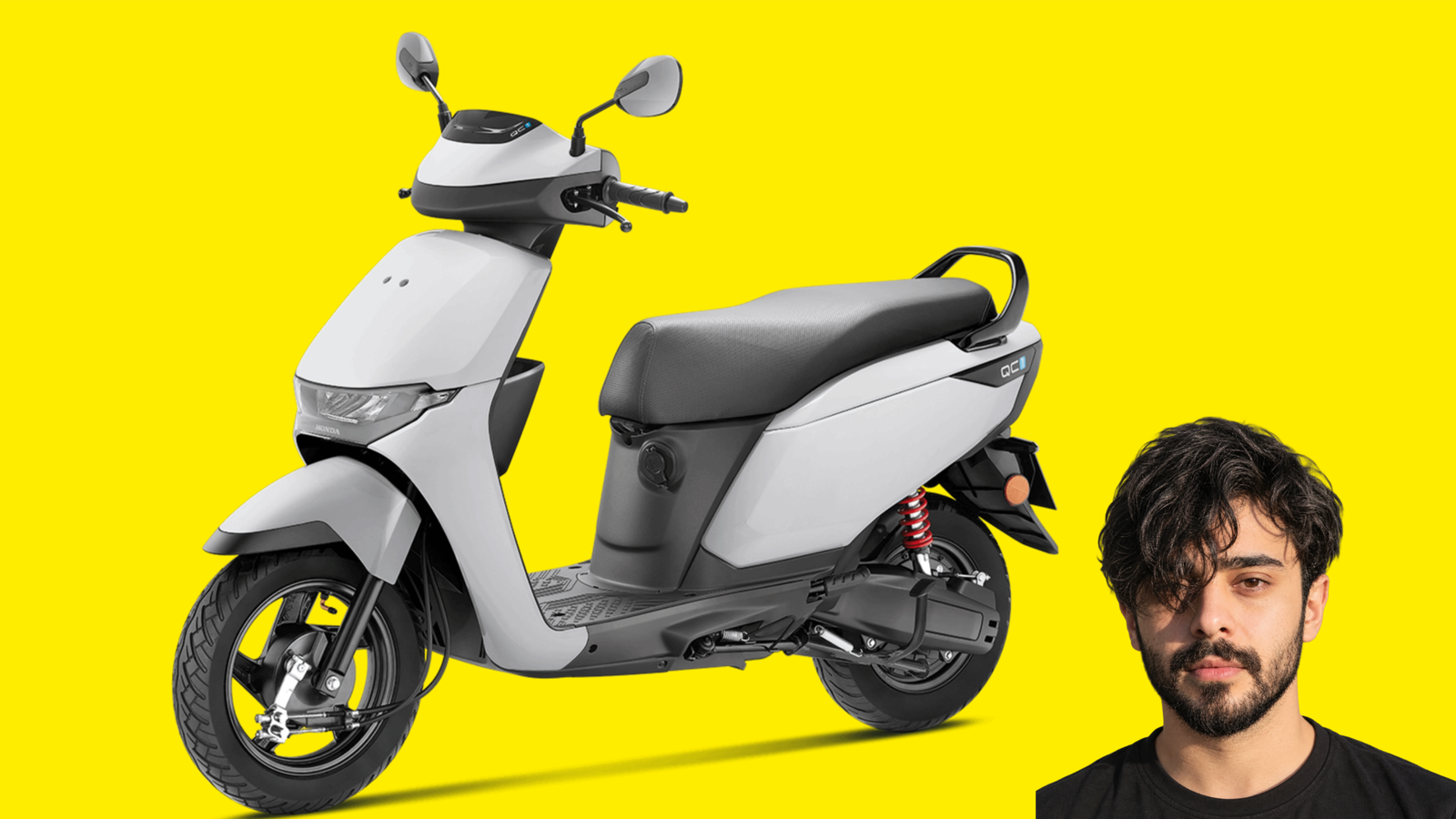
The Honda QC1 is a compact electric scooter designed for everyday city commuting and short-distance travel. Unlike the Honda Activa e:, the QC1 uses a fixed battery rather than a swappable battery system. Its lightweight construction, simple controls, 26-litre under-seat storage and low-speed performance make it particularly suitable for riders who mainly travel within the city.
Honda has focused on making the QC1 practical and easy to use rather than turning it into a high-performance electric scooter. It gets a 1.5 kWh lithium-ion battery, a 1.8 kW peak-output electric motor, a claimed IDC range of 80 km and a top speed of 50 km/h.
Honda QC1 Price in India
Honda introduced the QC1 at an introductory ex-showroom price of ₹90,000 in Bengaluru in January 2025. Honda’s current official EV website lists the QC1 from approximately ₹90,708, although the actual on-road price can vary depending on the state, city, registration, insurance and other charges.
Honda QC1 Price
Particular Honda QC1 Starting price From around ₹90,708 Original introductory price ₹90,000 Price type Ex-showroom Battery 1.5 kWh Claimed range 80 km IDC Top speed 50 km/h Motor peak power 1.8 kW
Buyers should check the latest quotation from an authorised Honda dealer because EV prices, registration charges and local benefits can change.
Honda QC1 Battery
The QC1 gets a 1.5 kWh fixed lithium-ion battery pack. Unlike the battery-swapping system used by the Activa e:, the QC1’s battery remains installed inside the scooter.
Honda says the battery uses BP cell chemistry, with a focus on energy density and long service life.
The battery is also rated IP67 for water and dust resistance, which is useful for normal Indian road and weather conditions.
Battery Specifications
- Battery type: Lithium-ion
- Battery capacity: 1.5 kWh
- Battery system: Fixed
- Cell chemistry: BP
- Battery protection: IP67
- Charger: 330W off-board charger
Honda QC1 Range
Honda claims an 80 km IDC range from the 1.5 kWh battery.
IDC range is measured under controlled testing conditions, so actual range in daily use can be lower or higher depending on rider weight, traffic, speed, road conditions, riding mode, tyre pressure and temperature.
For short city commutes, the QC1’s range should be more relevant than its highway capability because the scooter is designed around a 50 km/h top speed.
Real-World Range
The real-world range of any electric scooter varies considerably.
For example, frequent acceleration, carrying a passenger, riding at higher speeds and climbing slopes can increase energy consumption. Smooth riding in Eco mode and moderate speeds can help extract more kilometres from the battery.
Therefore, buyers should not assume that the 80 km IDC figure will always be achieved in everyday riding.
Honda QC1 Motor and Performance
The QC1 uses an in-wheel electric motor mounted at the rear wheel.
Honda lists a maximum motor output of 1.8 kW and maximum torque of 77 Nm.
The motor is designed for urban commuting rather than high-speed performance.
Performance Figures
- Motor type: BLDC/in-wheel motor
- Peak power: 1.8 kW
- Maximum torque: 77 Nm
- Top speed: 50 km/h
- 0-40 km/h: 9.4 seconds
- Gradeability: 7 degrees
The relatively low top speed means the QC1 is best suited to city roads and local commuting rather than expressways or high-speed highway travel.
Honda QC1 Riding Modes
The scooter gets two riding modes:
- Econ
- Standard
Econ mode prioritises efficiency and can be useful when the rider wants to maximise the remaining battery range.
Standard mode provides the more normal everyday riding experience.
Honda QC1 Charging Time
Honda supplies the QC1 with a 330W off-board charger.
The scooter can be charged using a standard household 6A power socket.
Charging Time
Charging Level Approximate Time 0-80% 4 hours 30 minutes 0-100% 6 hours 50 minutes
The charger uses CAN-controlled auto-cut technology, which automatically stops charging when the battery reaches the required level.
Because the charging speed is relatively slow, overnight charging is likely to be the most convenient approach for regular users.
Honda QC1 Running Cost
The QC1 has the potential to offer a low running cost compared with a petrol scooter.
Its actual electricity cost depends on the local electricity tariff and how efficiently the scooter is ridden.
For example, if a rider regularly travels short distances and charges at home, the cost per kilometre can be significantly lower than the fuel cost of a conventional petrol scooter.
However, electricity consumption, charging losses and local electricity rates should be considered when calculating the exact running cost.
Honda QC1 Design
The QC1 follows a simple and futuristic design language.
Honda has used smooth body panels and a relatively clean front section rather than giving the scooter an aggressive appearance.
The scooter gets:
- LED headlamp
- LED tail lamp
- LED indicators
- Integrated-looking front styling
- Large grab rail
- Alloy front wheel
- Compact rear section
Its lightweight body also makes it easier to manoeuvre through congested city streets.
Honda QC1 Weight
The QC1 has a kerb weight of approximately 89.5 kg.
This is one of the scooter’s important advantages.
A lighter electric scooter can be easier to:
- Move in parking areas
- Handle in traffic
- Park in tight spaces
- Push manually
- Manoeuvre at low speeds
This makes the QC1 particularly suitable for riders who prefer a lightweight scooter.
Honda QC1 Storage Space
The scooter offers 26 litres of under-seat storage.
This is a useful amount of space for everyday commuting and can accommodate items such as a charger, small bag and other personal belongings.
Honda also provides a 1.45-litre glove-box capacity.
Honda QC1 Display
The QC1 gets a 5-inch LCD instrument display.
The display provides important riding information such as:
- Speed
- Battery status
- Riding information
- Other essential vehicle information
Honda has kept the instrument cluster relatively simple instead of using a large touchscreen.
USB Type-C Charging
A USB Type-C port is provided inside the front storage area.
It can be used for charging compatible smartphones and other small electronic devices while travelling.
This is a useful feature for daily commuters who depend on their phone for navigation or communication.
Honda QC1 Brakes
The QC1 uses drum brakes at both ends.
Brake Setup
- Front brake: 130 mm drum
- Rear brake: 110 mm drum
Considering the scooter’s 50 km/h top speed and lightweight construction, this braking setup is designed around normal urban use.
Honda QC1 Suspension
At the front, the QC1 uses a telescopic suspension.
At the rear, it gets a five-step adjustable hydraulic suspension.
The adjustable rear suspension gives the rider some flexibility in setting the scooter up according to riding conditions and load.
Honda QC1 Wheels and Tyres
The QC1 gets different wheel sizes at the front and rear.
- Front tyre: 90/90-12
- Rear tyre: 90/100-10
- Front wheel: 12-inch alloy
- Rear wheel: 10-inch
The larger front wheel helps provide a stable feel over normal urban roads.
Honda QC1 Dimensions
Dimension Specification Length 1,826 mm Width 701 mm Height 1,129 mm Wheelbase 1,275 mm Ground clearance 169 mm Seat height 704 mm Kerb weight 89.5 kg Under-seat storage 26 litres
The 704 mm seat height is relatively accessible and can be helpful for shorter riders.
Honda QC1 Ground Clearance
The QC1 has 169 mm of ground clearance.
This gives the scooter reasonable clearance for common urban obstacles such as speed breakers and uneven patches of road, although riders should still approach large speed breakers carefully.
Honda QC1 Colours
Honda offers the QC1 in five colour options:
- Pearl Serenity Blue
- Matt Foggy Silver Metallic
- Pearl Igneous Black
- Pearl Misty White
- Pearl Shallow Blue
Colour availability may vary between dealerships and locations.
Honda QC1 Safety Features
The QC1 focuses on basic safety and practical urban riding.
Important equipment includes:
- LED lighting
- Front and rear drum brakes
- Telescopic front suspension
- Adjustable rear suspension
- IP67-rated battery
- CAN-controlled charger with auto-cut
- Side-stand related safety functions
- Parking brake mechanism
The scooter’s low 50 km/h top speed also reflects its intended use as a city-focused commuter.
Honda QC1 Warranty
Honda announced a standard warranty of 3 years or 50,000 km, whichever comes first, for the QC1.
Honda’s official current product information also lists 3 years/50,000 km for the vehicle, charger and battery.
Warranty terms should always be confirmed on the final purchase documents because coverage conditions can apply.
Honda also introduced an optional Care Plus package for its EV range, which can extend certain ownership benefits beyond the standard warranty period.
Honda QC1 Maintenance
One of the main advantages of an electric scooter is the simpler drivetrain compared with a petrol scooter.
The QC1 does not require:
- Engine oil changes
- Spark plug replacement
- Engine air-filter servicing
- Petrol engine maintenance
However, owners still need to maintain tyres, brakes, suspension, electrical components and other wear parts.
Battery charging habits and regular inspections can also contribute to long-term reliability.
Honda QC1 Service Network
The QC1 is sold and supported through selected Honda dealerships and EV support locations.
Before purchasing, buyers should confirm that an authorised Honda EV service facility is available close to their home.
This is particularly important because EV-specific diagnosis and battery-related service may require trained technicians and dedicated equipment.
Honda QC1 vs Honda Activa e:
The two Honda electric scooters have very different purposes. Feature Honda QC1 Honda Activa e: Battery 1.5 kWh fixed 2 × 1.5 kWh swappable Claimed range 80 km IDC 102 km IDC Motor peak power 1.8 kW 6 kW Top speed 50 km/h 80 km/h Storage 26 L Around 26 L Riding focus Short city trips More powerful urban riding Charging Home charging Battery swapping system
The QC1 is the simpler and more affordable option, while the Activa e: offers substantially stronger performance and a battery-swapping system.
Who Should Buy the Honda QC1?
The QC1 can make sense for buyers who:
- Mostly ride within the city
- Travel relatively short distances every day
- Want a lightweight electric scooter
- Prefer Honda’s established service ecosystem
- Have access to home charging
- Do not need highway performance
- Want a simple EV without a complicated feature list
- Value low-speed, easy-to-manage commuting
Who Should Avoid the Honda QC1?
The QC1 may not be the ideal choice if you:
- Regularly travel on highways
- Need speeds above 50 km/h
- Frequently travel long distances
- Want fast charging
- Want a removable battery
- Expect strong acceleration
- Need advanced smartphone connectivity
- Frequently ride with a passenger over long distances
For such users, a more powerful electric scooter may be a better choice.
Honda QC1 Pros
- Honda brand and dealership support
- Lightweight 89.5 kg kerb weight
- 80 km claimed IDC range
- 26-litre under-seat storage
- 1.5 kWh lithium-ion battery
- IP67 battery protection
- USB Type-C port
- LED lighting
- Five colour options
- Simple operation
- Low-speed city-friendly design
Honda QC1 Cons
- 50 km/h top speed is low
- Long 6 hour 50 minute full charging time
- Fixed battery cannot be removed for charging elsewhere
- Only 1.5 kWh battery capacity
- No high-performance riding capability
- Basic LCD display
- Drum brakes at both ends
- Not designed for regular highway use
Honda QC1 FAQs
What is the price of Honda QC1?
Honda’s current official website lists the QC1 from around ₹90,708, while its original introductory ex-showroom price was ₹90,000 in Bengaluru.
What is the range of Honda QC1?
The Honda QC1 has a claimed IDC range of 80 km.
What is the battery capacity of Honda QC1?
It uses a 1.5 kWh fixed lithium-ion battery.
What is the top speed of Honda QC1?
The Honda QC1 has a claimed top speed of 50 km/h.
How powerful is the Honda QC1 motor?
The in-wheel motor produces a maximum output of 1.8 kW.
Does Honda QC1 have a removable battery?
No. The QC1 uses a fixed battery.
How long does Honda QC1 take to charge?
It takes approximately 4 hours 30 minutes to reach 80% and around 6 hours 50 minutes for a full 0-100% charge.
Does Honda QC1 have fast charging?
The QC1 is supplied with a 330W off-board charger and is not positioned as a fast-charging electric scooter.
How much storage does Honda QC1 have?
It has 26 litres of under-seat storage.
What is the seat height of Honda QC1?
The QC1 has a seat height of approximately 704 mm.
Is Honda QC1 good for daily use?
Yes, if your daily travel is mainly within the city and you are comfortable with its 50 km/h top speed and relatively slow charging.
Is Honda QC1 suitable for highway riding?
It is not intended for regular high-speed highway use. Its 50 km/h top speed makes it much more suitable for local and urban commuting.
Final Verdict
The Honda QC1 is a straightforward electric scooter aimed at practical city transportation rather than performance. Its biggest strengths are its lightweight body, 80 km claimed IDC range, 26-litre storage, simple controls and Honda’s established service presence.
The biggest limitations are its 50 km/h top speed, fixed battery and long charging time. Therefore, the QC1 makes the most sense for riders who have a predictable daily commute and can charge the scooter at home.
For short-distance urban travel, the Honda QC1 can be a practical entry-level EV. Buyers who require higher speed, stronger acceleration or longer-distance capability should consider a more powerful electric scooter before making a decision.
Important Information
All specifications, prices and features mentioned in this article are based on information available from Honda and other published sources at the time of writing. Prices, colours, availability, warranty terms and equipment can change by city or model year. Always confirm the final price and specifications with an authorised Honda dealer before purchasing.
This article is independently written for informational purposes. Honda, QC1 and related product names are trademarks of their respective owners.